
[2026 Nameology] Must-Read for Changing Your Name to Change Your Luck! 7 Naming Keys You Can't Afford to Miss
免費 AI 八字排盤
10 個國際頂尖 AI 模型各自獨立批算再交叉覆核, 並由 1700 年起推演干支,找出與你年、月、日三柱完全相同的歷史真人對照。免費、無需留 Email。
Practical Naming Strategies and Taboos
Fundamental Theories and Core Concepts of Nameology
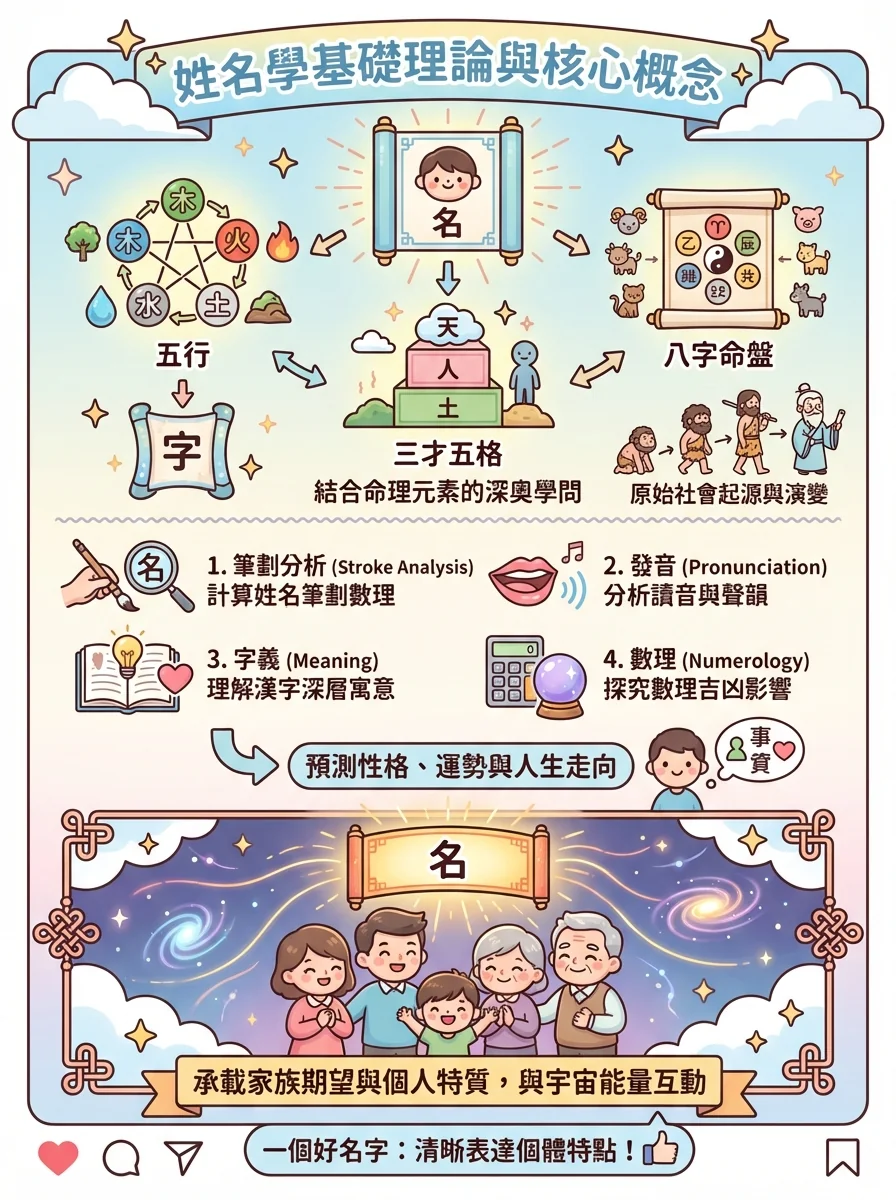
Hey, where did your name come from? Do you think naming is just about randomly picking two characters and putting them together? Young one, you're too naive! "Nameology" is actually a very profound field of study, far from being as simple as you might think. It's not just a name, a label, but a blend of the essence of Chinese metaphysics like the Five Elements, the Three Talents and Five Elements, and your Bazi (Four Pillars of Destiny) chart, used to study how to give a person a good name to enhance their fortune.
Simply put, the core of nameology is to analyze the strokes, pronunciation, meaning of the characters, and even the underlying numerology of your name to see your personality, how your luck will flow, and even the direction of your entire life. In our Chinese society, a name is not just your social tag; it carries the expectations of your entire family, reflects your personal traits, and even interacts with the energy field of the universe. A good name is like a tailor-made suit, clearly expressing your personality, interests, pursuits, and ideals, and even has the power to influence and change your personal aura and energy!
與其自己猜,不如讓 10 個 AI 一齊批:
• 今年運勢是好是壞?
• 財運事業運何時到?
• 哪個時期最適合投資?
Among these, "Five Elements Balance" is one of the most core theories in nameology. What are the Five Elements? They are Metal, Wood, Water, Fire, and Earth. A good name should make these five elements harmonious and complementary within your destiny. For example, if Bazi analysis reveals you are inherently lacking the "Fire" element, then when choosing a name, you can consider adding characters associated with Fire, like "炎" (Yan) or "煒" (Wei), using postnatal power to supplement what your destiny lacks. There's also the "Three Talents and Five Elements," which are Heaven, Man, Earth, Outer, and Total Strokes. This system uses another calculation method to analyze your fortune at different life stages. Besides, there are many different schools of nameology; some focus on the Chinese zodiac, while others specialize in stroke counting, like the Five Elements Analysis method originating from Japan. So, this isn't about superstition; it's a tool of traditional cultural wisdom that helps us understand ourselves and improve our luck. Whether it's naming a baby or an adult wanting to change their name for better fortune, many people seriously consider the principles of nameology, hoping to bring positive energy into their lives.

Practical Naming Strategies and Taboos
Three Talents, Five Elements, and Stroke Numerology Analysis
When talking about nameology, how can we not mention the "Three Talents and Five Elements"? This is arguably the most key part of analyzing name structure. The "Three Talents" refer to Heaven, Man, and Earth Strokes. The interplay of generation and restriction among their Five Elements can reveal how your innate, acquired, and internal fortunes interact. The "Five Elements" add the Outer and Total Strokes to the Three Talents, forming a more complete analytical framework.
So how is it calculated? Let me explain briefly:
一個 AI 可能錯,10 個一齊講同一件事呢?
- Heaven Stroke: The stroke count of your surname (add one stroke for single-character surnames; sum the strokes for two-character surnames). It represents the ancestral blessings and innate fortune.
- Man Stroke: The stroke count of the last character of the surname plus the first character of the given name. This is the core of the entire name, mainly influencing your mid-life fortune and personality.
- Earth Stroke: The total stroke count of your given name (excluding the surname). It represents your early-life luck, foundation, and relationship with children.
- Outer Stroke: The total strokes minus the Man Stroke strokes. It looks at your interpersonal relationships, social skills, and whether you have help from benefactors.
- Total Stroke: The total stroke count of the entire name. It governs your late-life fortune.
The ideal Three Talents configuration is continuous generation of the Five Elements, e.g., "Wood generates Fire, Fire generates Earth," which means your path will be smooth, with easy support from benefactors. Conversely, if restrictive combinations like "Metal restricts Wood, Wood restricts Earth" appear, it may indicate more obstacles in life, a more contradictory personality, or even health issues. However, restriction isn't necessarily bad; sometimes it can stimulate fighting spirit. The most important thing is to look at your overall Bazi chart for a holistic balance.
It's important to note that this calculation must use the traditional Chinese character stroke counts from the "Kangxi Dictionary," not simplified characters, because many characters have completely different stroke counts and Five Elements attributes after simplification. For example, the character "傑" (Jie) has 12 strokes and belongs to Wood in traditional form, but it changes in simplified form, leading to vastly different results! Additionally, there's the 81-number numerology table of auspiciousness and inauspiciousness. Different stroke counts have different meanings; for instance, 21 strokes is a leadership pattern (auspicious), but 34 strokes signifies ruin and loss (very inauspicious). When choosing a name, one should seek the auspicious and avoid the inauspicious. Speaking of this, are you curious to know if your name's Three Talents and Five Elements configuration is good? Actually, there's a very convenient method now: try Master Xuanshen's Free Divination Service. They can provide results in as fast as 3 hours and can also analyze your annual fortune for 2026. The most important thing is it's completely free. You'd be missing out if you don't try it!

Practical Naming Strategies and Taboos
Bazi Chart and the Law of Five Elements Balance
Just talking about stroke numerology isn't enough. The most professional approach nowadays is to combine nameology with your "Bazi chart," with the ultimate goal of achieving "Five Elements Balance." What is Bazi? It's the eight characters derived from converting your birth year, month, day, and hour into Heavenly Stems and Earthly Branches, which conceal the distribution of your innate Five Elements energy. Through a professional destiny analysis, one can determine which Five Elements are too strong or too weak in your Bazi and which are your favorable "Useful Gods."
同一個盤,前人走過怎樣的路?
The greatest function of a good name is to help you "remedy imbalances and rescue deficiencies," like taking supplements. It uses the Five Elements attributes of the characters themselves to balance the elements you lack or have in excess in your Bazi, thereby achieving postnatal harmony and boosting fortune. How to do it specifically? First, a professional master needs to calculate your Bazi to find your destiny's "Useful Gods," the Five Elements most beneficial to you. For example, if a baby's Bazi shows "Wood" is too strong, according to the principle of "Metal restricts Wood," when naming, characters associated with "Metal" should be added, like "鋒" (Feng) or "銘" (Ming), to suppress the Wood energy. At the same time, avoid using more characters associated with "Wood" or "Water" (because Water generates Wood) to prevent adding fuel to the fire.
Imbalance in the Five Elements greatly affects personal character and fortune. For instance, a person whose destiny has overly strong "Wood" might become very stubborn and hot-tempered if their name further strengthens Wood energy. Conversely, if someone's destiny is very weak in "Metal," they may lack decisiveness. If their name can supplement Metal energy, it can help improve their decisiveness and wealth luck. Of course, Five Elements remedy isn't simple addition and subtraction; it also needs to consider the Three Talents and Five Elements, zodiac preferences and taboos, character sound and meaning, etc. For example, for a baby born in the year 2026 (Yi Si year), if their Bazi shows strong Fire and Earth, then naming should prioritize characters associated with Metal and Water. For parents planning a C-section, they can even first choose an auspicious time with balanced Five Elements, then pair it with a good name that can support this Bazi, helping the child build a good foundation and win at the starting line! The same principle applies to adults changing their names; adjusting the Five Elements of a name can also have a very positive impact on career, wealth, and interpersonal relationships.
Practical Naming Strategies and Taboos
Zodiac Preferences and Zi Wei Dou Shu Application
Besides Bazi and the Five Elements, nameology has two other commonly used reference systems: the "Chinese Zodiac" and "Zi Wei Dou Shu (Purple Star Astrology)." They approach naming from different angles, making it more three-dimensional and personalized.
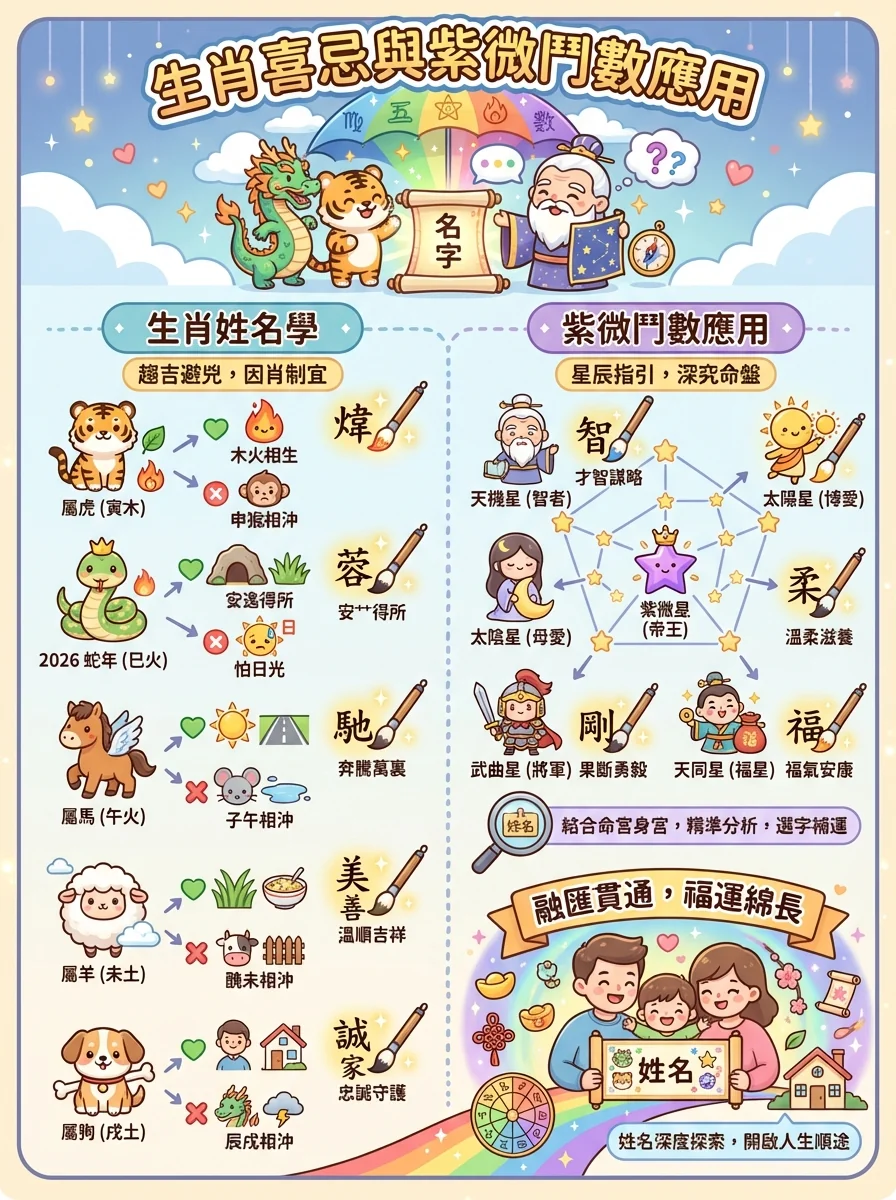
First, let's talk about Zodiac Nameology. This method judges which characters are suitable or unsuitable based on the characteristics, habits, and the Earthly Branches' Five Elements relationships of the twelve zodiac animals. The core idea is simple: "Seek the auspicious, avoid the inauspicious," choosing character radicals (components) beneficial to your zodiac sign and avoiding those that clash or harm it. For example, people born in the Year of the Tiger (Yin Wood) have inherently strong Wood. When naming, they can choose characters with the "Fire" radical (like "炎" or "煒") to form Wood generating Fire, which is beneficial for showcasing talent. But they should avoid characters with the "申" (Shen) or "猴" (Monkey) radicals because "Yin clashes with Shen," meaning Tiger and Monkey clash. Another example: 2026 is the Year of the Snake. Snakes like to hide in caves or grass, so characters with radicals like "口" (mouth), "艹" (grass), or "宀" (roof) (e.g., "蓉" (Rong), "安" (An)) are good, representing shelter and comfort. But snakes fear the sun, so characters with the "日" (sun) radical should be avoided. Each zodiac sign has its own set of suitable and unsuitable characters. For instance, Dragons like "雲" (cloud), "辰" (Chen); Horses like "駿" (Jun), "騰" (Teng); Rats most dislike "午" (Wu), "馬" (Horse). Choosing characters that match the zodiac aims to strengthen your strengths and avoid innate weaknesses.免費八字排盤
Next is Zi Wei Dou Shu Nameology, a more professional and refined approach. It combines your entire Zi Wei Dou Shu chart with nameology. Zi Wei Dou Shu can precisely analyze your innate personality, talents, fortune fluctuations, and the characteristics of stars in different palaces (e.g., Life Palace, Wealth Palace, Marriage Palace). When naming, characters can be chosen based on what your chart reveals to achieve the effect of "echoing talents and stimulating potential." For example, if someone's Life Palace's ruling star is "Po Jun" (Breaking Army), indicating an impulsive and pioneering personality, then naming can choose characters with the Five Elements attribute "Earth" to add stability, avoiding "Fire" characters that might increase volatility. If the Wealth Palace has the wealth star "Wu Qu" (Military) (belonging to Metal), adding characters with the "Metal" attribute (e.g., "鋒") to the name can enhance wealth luck. This method is not only suitable for naming babies; adults wanting to change their names can also use the power of a new name to harmonize personality and strengthen palaces they wish to improve, making their path smoother. Does it sound complicated? You need to look at Bazi, the zodiac, and Zi Wei Dou Shu! If you want to understand your destiny all at once and learn more about your 2026 fortune, why not try Master Xuanshen's Free Divination Service? Results in as fast as 3 hours, and the key point is it's completely free, helping you understand yourself comprehensively!
Practical Naming Strategies and Taboos
即時四柱五行排盤 + 命格角色卡,由十神實算,配以過萬真實命例大數據交叉分析。
Practical Naming Strategies and Taboos
Whether you're naming a baby, changing your own name for better luck, naming a company, or choosing a stage name, besides following the theories mentioned above, there are many practical strategies and taboos to note. Only then can you ensure the name truly brings positive influence, not the opposite.
What shouldn't you do when naming a baby?
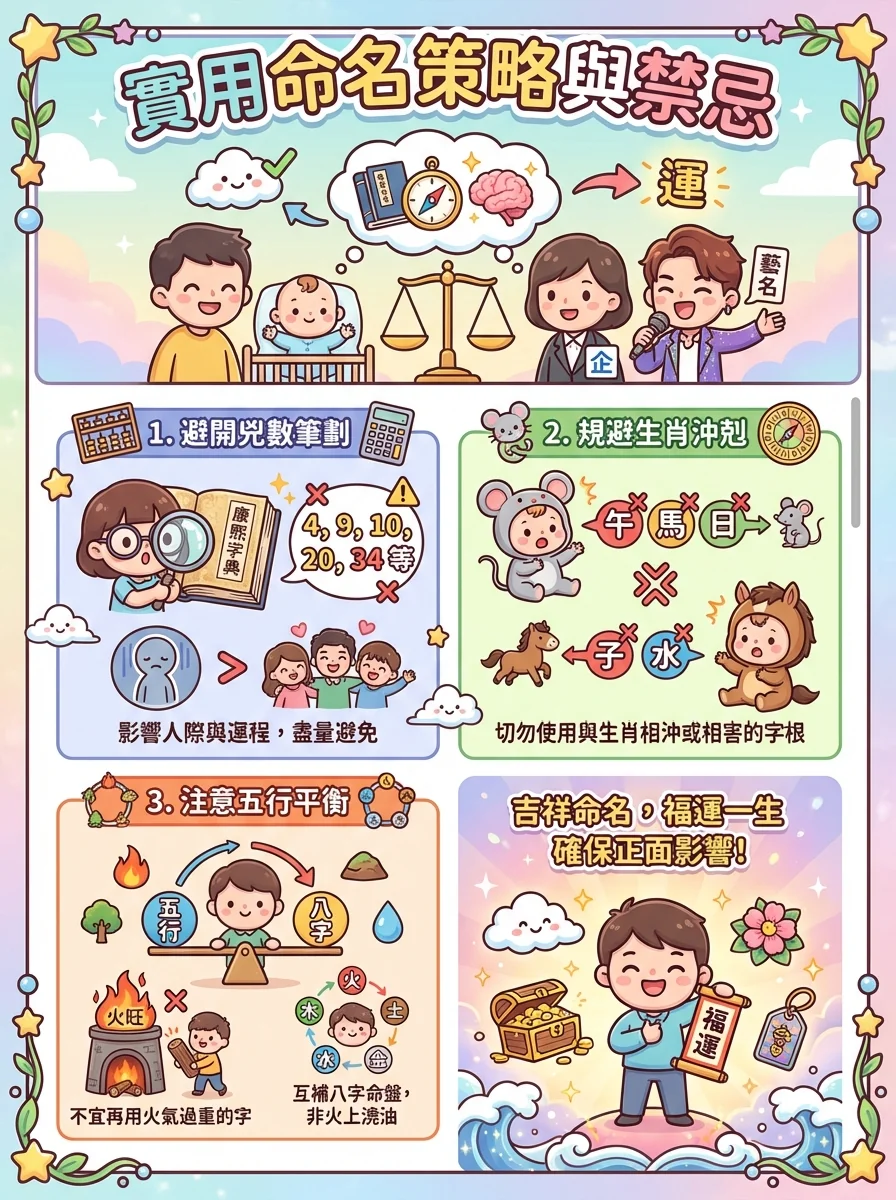
- Avoid Inauspicious Stroke Numbers: According to nameology theory, some stroke numbers (like 4, 9, 10, 19, 20, 34 strokes, etc.) are inauspicious or lonely numbers, which may affect relationships and luck. Definitely avoid them. Remember, stroke counting must use traditional Chinese characters from the "Kangxi Dictionary" as the standard!
- Don't Use Characters that Clash with the Zodiac: This is a major taboo! For example, if the baby is born in the Year of the Rat, avoid characters with radicals like "午," "馬," "日"; if born in the Year of the Horse, avoid radicals like "子," "水."
- Pay Attention to Five Elements Balance: The Five Elements attributes of the name should be used to supplement what the baby's Bazi lacks, not add fuel to the fire. If the baby's Bazi already has very strong Fire, don't use characters with heavy Fire energy, as it will make their personality more irritable.
- Don't Use Obscure Characters: Although using characters no one knows might seem cultured and unique, it actually brings huge trouble! In the future, when the child registers for things, takes exams, socializes, or even types their name on a computer, they might not be able to find the character. It's really not worth the trouble.
- Beware of Unfortunate Homophones: After choosing a name, be sure to read it aloud several times in Cantonese and Mandarin to see if there are any unfortunate or funny homophones, like "X偉健" (sounds like "喂賤" - hey, cheap). To prevent your child from being laughed at in school, this step is essential!
How to handle adult name changes and stage names?
Adults changing their names or choosing stage names usually do so to change their luck, with clear goals, often wanting better career, wealth, or relationships. Strategically, besides following the basic principles of Five Elements, zodiac, and strokes, you should also combine them with your current industry and future development plans. For example, those in creative fields can choose characters related to the Literary Star, like "文" (Wen) or "穎" (Ying); those wanting to enhance leadership can choose stroke combinations with leadership numerology. Stage names require even more consideration; the name must be catchy, memorable, and able to shape a distinct personal image. A good stage name can definitely boost audience appeal and career luck!
Company Naming Strategy
Company naming is also very particular. Not only should you consider the boss's Bazi and Five Elements (ideally, the company name and the boss should have a generating relationship), but you should also combine it with the industry. For example, tech companies are more suited to characters like "科" (Ke), "創" (Chuang), "智" (Zhi); traditional industries prefer characters with good connotations like "興" (Xing), "隆" (Long), "發" (Fa). The total stroke count of the company name is also very important; auspicious numbers should be chosen, hoping for stable operations and long-lasting business. At the same time, the name should be easy to spread, memorable, and able to reflect the brand's value and market positioning to be a good name.
What exactly is Nameology? How is it different from fortune-telling?
Nameology is a traditional metaphysical study that believes the strokes, pronunciation, meaning, and structure of a name can influence a person's fortune, personality, and health. It's not just fortune-telling; it focuses more on adjusting and optimizing the deficiencies of one's innate destiny through postnatal name changes. It's considered an active method of "creating luck," rather than passively predicting the future.免費 AI 八字排盤
How do I know what my Five Elements are? What's the relationship with Nameology?
To know your Five Elements attributes, the most accurate method is to calculate based on your birth year, month, day, and hour (i.e., your "Bazi"). The Heavenly Stem representing you, the "Day Master," is your core life element. In nameology, knowing your favorable and unfavorable Five Elements is crucial because when changing your name, you need to select characters that can supplement the elements your destiny lacks or needs.
How does "Five Elements Restriction" in Nameology affect me?
In the "Three Talents and Five Elements" configuration of nameology, if a Five Elements restriction situation occurs—for example, if the Man Stroke (representing you) restricts the Heaven Stroke (representing elders)—it may indicate tension with superiors or elders, or a rebellious mindset. Smooth flow and generation of the Five Elements are auspicious, while restriction tends to create obstacles and conflicts in corresponding areas like relationships, health, or career.
What are the zodiac-based suggestions for naming a baby born in 2026 (Year of the Horse)?
2026 is the Bing Wu Year of the Horse. According to zodiac nameology, when naming a Horse baby, you can choose character radicals that are beneficial to the Horse. For example, horses eat grass, so characters with the "艹" (grass) radical symbolize ample food and clothing. Horses look more handsome adorned, so radicals like "彡" (ornament) and "巾" (cloth) are also good choices. However, zodiac suggestions are just one part; the most important thing is to match the baby's Bazi and Five Elements.
How accurate is using Nameology to match couples or business partners?
Nameology matching can serve as a reference tool to analyze the magnetic field and interaction patterns between two people, but it absolutely cannot be the sole criterion for judgment. It can reveal potential points of compatibility and conflict in personalities, but the success of a relationship ultimately depends on actual communication, effort, and mutual understanding. Therefore, this method has reference value but is not recommended to be taken as gospel.
If I want to change my name to change my luck, what's the procedure and what should I pay attention to?
In Hong Kong, to improve your fortune by changing your name, first find a trustworthy nameology expert to design a new name, then go through a law firm to complete a "Deed Poll." After successfully changing your name, the most crucial step is to thoroughly update all personal documents, such as your ID card, passport, bank accounts, insurance, etc., to ensure the new name is fully effective legally and in daily life.
What is the approximate cost of name change services? Is more expensive more guaranteed?
The price range for name change services is very wide, from a few hundred dollars for online software analysis to several thousand or even over ten thousand dollars for in-person consultations with experienced masters. The price usually reflects the master's reputation, experience, and the level of detail in the service. However, more expensive isn't necessarily better. The most important thing is to find a professional you can communicate with, trust, and who explains things clearly.
Does Nameology analysis require an in-person meeting? Are online analyses reliable?
Traditionally, many people prefer in-person meetings for immediate interaction and in-depth questioning. However, with technological development, many experienced practitioners also offer professional online analysis services with quality on par with in-person sessions. When choosing an online service, the most important thing is to select a platform or expert with a good reputation and clear background, avoiding those unknown free automatic generators.