
[2026 Spouse Palace] What to Do If Your Marriage Luck Isn't Smooth? Check Out 7 Key Points to Improve Your Relationship Fortune
免費 AI 八字排盤
10 個國際頂尖 AI 模型各自獨立批算再交叉覆核, 並由 1700 年起推演干支,找出與你年、月、日三柱完全相同的歷史真人對照。免費、無需留 Email。
Advanced Dynamic Analysis: Using Four Transformations and Flying Stars to Predict Emotional Changes and Avoid Marriage Pitfalls
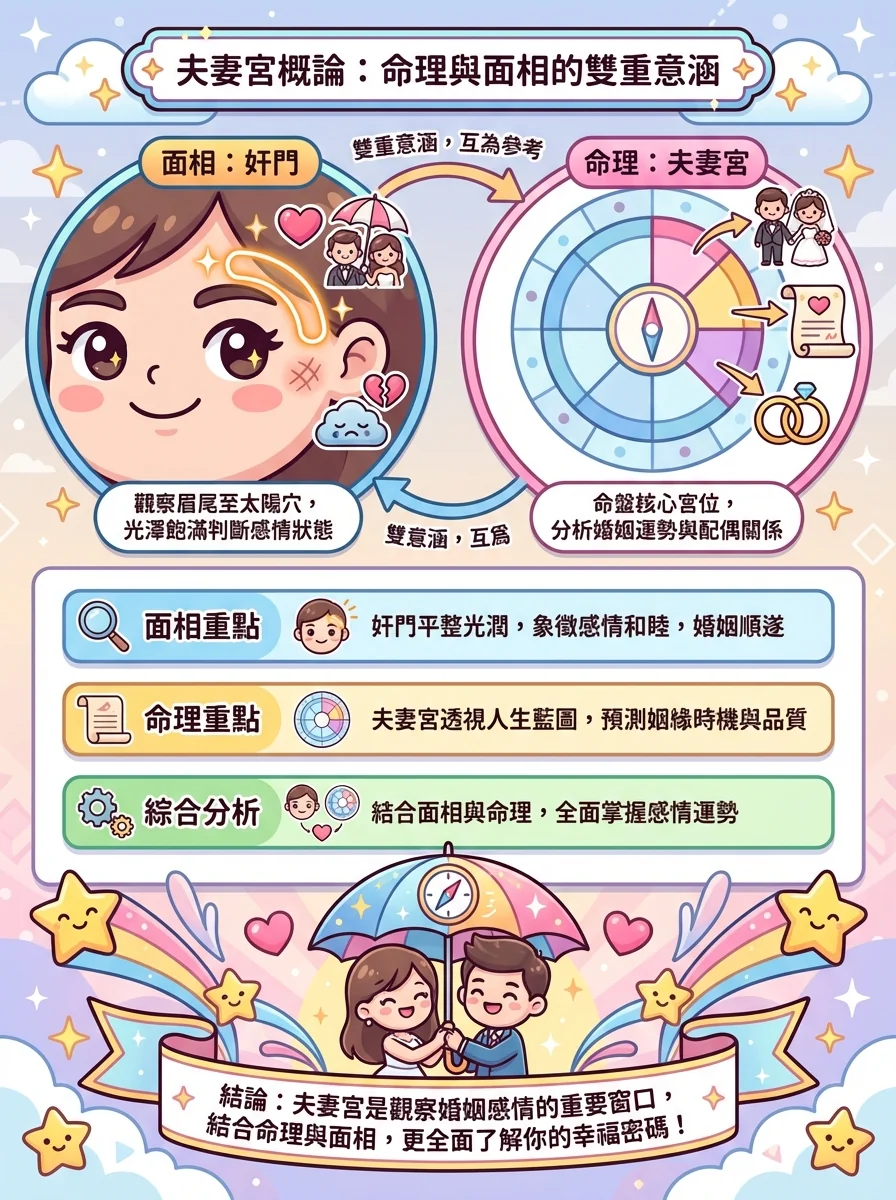
Spouse Palace Overview: The Dual Meanings of Fortune-Telling and Physiognomy
When it comes to the term "Spouse Palace," in the context of Chinese metaphysics, it actually has two layers of meaning. Firstly, in traditional physiognomy (face reading), the "Spouse Palace" is also known as the "Jian Men" (Adultery Gate), referring to the skin area from the tail of the eyebrow extending to the temple. There's an old saying that if this area has flaws, such as scars, birthmarks, or moles, it might indicate disharmony in marital life or a more challenging romantic path. The fullness and luster of this area are used as indicators to assess a person's marital and emotional status.
However, nowadays, more people are familiar with the "Spouse Palace" in fortune-telling, especially in Zi Wei Dou Shu (Purple Star Astrology) and BaZi (Four Pillars of Destiny). Simply put, in traditional fortune-telling systems, each person's life blueprint, known as the "destiny chart," is divided into different "palaces," each representing a crucial aspect of life. The "Spouse Palace," as the name suggests, is the core position specifically used to examine a person's marriage luck and relationship with their partner. It's not just about predicting when you'll get married; it's a window that can provide deep insights into your future partner's personality, appearance, family background, how you interact, the depth of your connection, potential conflicts, and whether the marriage will be auspicious or inauspicious. Some masters describe the Spouse Palace as the "personal file" of your destined partner, and the information within requires careful chart analysis to understand.
In the Zi Wei Dou Shu system, the Spouse Palace is a very important part of the twelve palaces. In your destiny chart, the Spouse Palace contains major and minor stars, known as "star luminaries." Each star has different characteristics, like people with different personalities. If the Spouse Palace contains auspicious stars, such as those representing gentleness, virtue, or wealth, it usually indicates a good partner or a harmonious relationship where you can receive help from them. Conversely, if it contains malevolent stars or stars with solitary or conflicting natures, it may suggest a marriage with more ups and downs, prone to arguments, estrangement, or even challenges like early marriage instability, better luck with late marriage, or separation/bereavement. Of course, fortune-telling analysis is never based on a single star; the key is to look at the entire star combination and its interaction with other palaces (like your own Life Palace and Virtue Palace), which produces ever-changing marriage predictions.
與其自己猜,不如讓 10 個 AI 一齊批:
• 今年運勢是好是壞?
• 財運事業運何時到?
• 哪個時期最適合投資?
Besides Zi Wei Dou Shu, other fortune-telling schools also use the concept of the Spouse Palace. For example, in BaZi (commonly known as the Eight Characters), the Day Pillar (the heavenly stem and earthly branch of the birth day) represents oneself, and the "Day Branch" below it is precisely our "Spouse Palace." By analyzing the Five Elements and Ten Gods contained within the Day Branch, one can also see the spouse's personality, traits, and even their family background and general appearance. If the Day Branch is your "Useful God" (a favorable element), your partner will likely be very helpful; if it's a "Harming God," there may be more friction in the relationship. So, regardless of the school of thought, the Spouse Palace is crucial for analyzing marriage and partner conditions.
A responsible fortune-telling analysis would never judge a relationship solely based on the Spouse Palace. Experienced masters always emphasize "comprehensive cross-referencing," meaning integrating other information. For example, examining the distribution of Peach Blossom stars representing overall romantic luck; looking at the opposite palace of the Spouse Palace (the Career Palace), as it affects your partner's career development and your attitude towards marriage; and even referencing major and annual cycles to see when the timing is best for love to blossom. Some people also combine name analysis, I Ching, and even physiognomy and Feng Shui perspectives for a more comprehensive marriage compatibility or consultation, aiming to understand their destiny and romantic trajectory more holistically.
In summary, the "Spouse Palace" is not a mysterious black box but a long-established, systematic tool for chart analysis. Its value lies in providing a perspective, allowing us to foresee the potential scenery and obstacles on our marital path, enabling wiser planning and management of this important life relationship. Understanding the characteristics of your Spouse Palace, whether strong or weak, blessed by auspicious stars or needing to resolve negative influences, ultimately aims at self-awareness and relationship improvement, not fatalism. Remember, the best use of any divination or fortune-telling tool, including Spouse Palace chart interpretation, is as a reference for self-reminder and life planning, not as an absolute prophecy causing unnecessary panic. Want to know your 2026 romantic fortune? Why not try Master Xuan Shen's Free Divination Service? Results in as fast as 3 hours, including 2026 annual fortune analysis, completely free, very convenient!
Advanced Dynamic Analysis: Using Four Transformations and Flying Stars to Predict Emotional Changes and Avoid Marriage Pitfalls
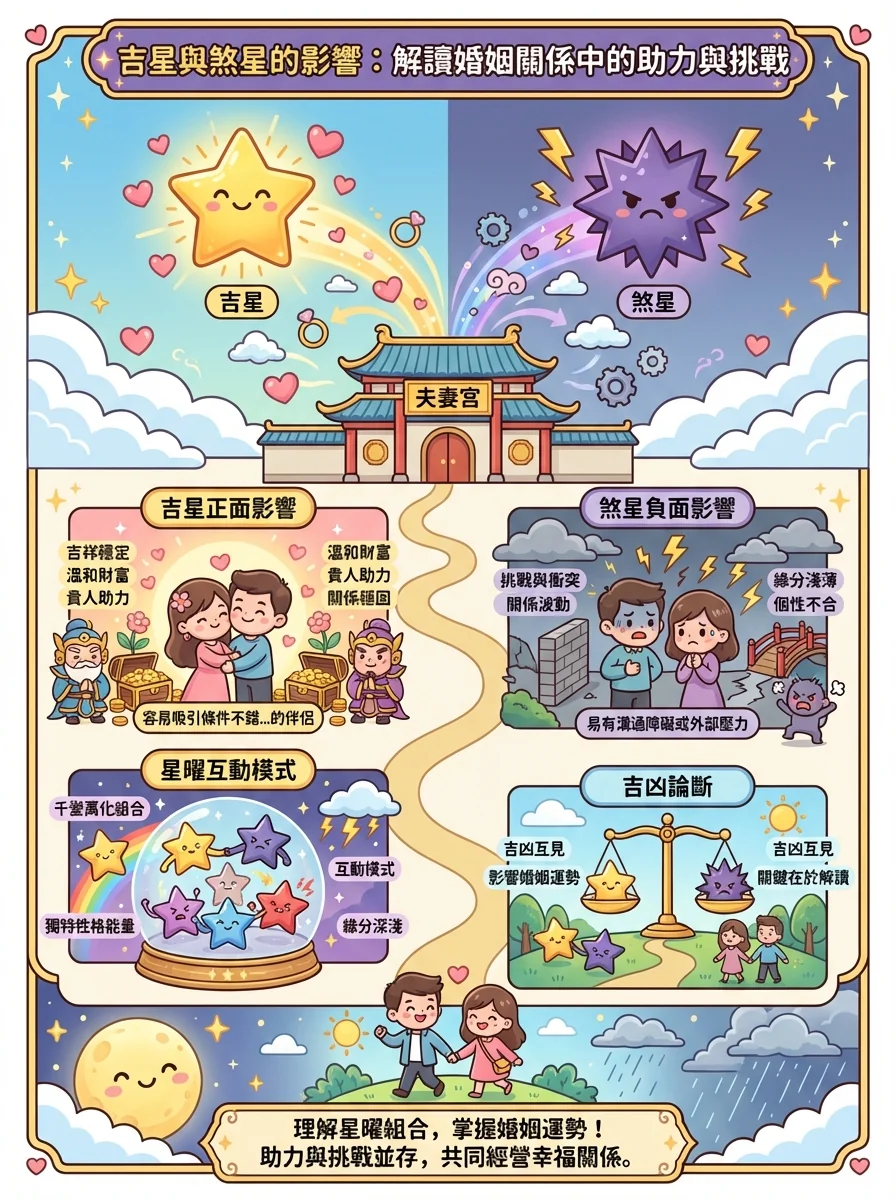
The Influence of Auspicious and Malevolent Stars: Interpreting Support and Challenges in Marriage Relationships
Alright, after covering the basic concept of the Spouse Palace, let's delve deeper into how the stars within the palace affect your marriage fortune. In the intricate Zi Wei Dou Shu system, each star has its unique personality and energy. Placed in the special position of the Spouse Palace, they directly reflect your interaction patterns with your partner, the depth of your connection, and even the types of challenges you might encounter. Simply put, they can be divided into two camps: auspicious stars and malevolent stars. Their combinations are ever-changing and significantly impact the auspiciousness or inauspiciousness of your marriage.
First, let's talk about the positive influence of auspicious stars. If your Spouse Palace contains stars traditionally considered lucky, stable, and supportive—such as those representing gentleness, wealth, helpful people, or talent—it's usually a good sign. These auspicious stars often mean you are likely to attract a partner with good qualities, a relatively gentle personality, or one who offers practical help. The foundation of the relationship tends to be more stable, communication is smoother, and even if there are arguments, they are more easily mediated or resolved naturally, avoiding severe deadlock. For instance, some stars indicate your partner might be your "wealth star," whose presence or financial acumen could boost your overall wealth; others suggest a spouse who is refined and values family harmony. Of course, it's also important to see if the star is in a "strong" or "flourishing" state. If an auspicious star is strong and radiant, its positive power is naturally greater; if weak, its influence diminishes. Therefore, a professional master analyzing a chart would never judge based on a single star alone but must consider the entire chart.
However, the world isn't perfect. If there are malevolent stars in the Spouse Palace, don't panic immediately! Malevolent stars typically represent challenges, pressure, change, and tests. Common malevolent stars include those representing impulsiveness, disputes, separation, or excessive obsession. When they appear in the Spouse Palace, they may indicate more turbulence in your marriage. For example, prone to intense arguments with your partner, significant clashes in values, or emotional tests due to external factors (like a busy career, mother-in-law issues). More severe combinations are traditionally called "conflicts and clashes," possibly hinting at risks of separation/bereavement within the relationship, or a particularly winding romantic path requiring several relationships before success, forming a so-called "late marriage" pattern. For those with heavy malevolent star influence, masters might even advise against marrying too early, suggesting waiting until mental maturity improves or luck turns better before handling marriage—these are practical methods to attract good fortune and avoid harm.
一個 AI 可能錯,10 個一齊講同一件事呢?
The most crucial point is the art of "star combinations." Few Spouse Palaces contain only one auspicious or malevolent star; most have a mix, like a big pot of stew. This is where the essence of chart analysis comes in! For example:
- Auspicious star power stronger than malevolent stars: May represent "bitterness first, sweetness later." Early dating or the first few years of marriage might have more arguments (influence of malevolent stars), but over time, or after certain experiences, the partner's strengths and support (influence of auspicious stars) gradually emerge, making the relationship more stable. Some couples "argue their whole lives" but actually have a very deep emotional foundation.
- Malevolent star power overwhelming auspicious stars: Then you really need to be extra vigilant. Challenges in the relationship become the main theme, requiring immense effort and wisdom to manage. Here, the value of fortune-telling analysis is early warning, allowing the chart owner to know their blind spots and potential trouble areas, thus consciously improving communication, choosing a partner more suited to their destiny, or paying special attention to maintaining the relationship in specific years.
- Special "paired stars" or "star group" combinations: In Zi Wei Dou Shu, some stars appear in pairs, or several stars form a specific pattern. When they fall into the Spouse Palace, their influence on the spouse's personality and the relationship becomes more complex and intense. Some patterns indicate a capable but hot-tempered spouse; others indicate a beautiful spouse with many admirers. These require careful interpretation by a master.
So, when you look at your chart and see malevolent stars in the Spouse Palace, absolutely don't scare yourself into thinking divorce is inevitable. The role of fortune-telling is not to sentence you but to give you a "map" and "weather forecast" for your relationship. Knowing which road has many curves or when it will rain allows you to prepare an umbrella or drive slower. For instance, knowing your Spouse Palace has a certain malevolent star prone to causing arguments, you can consciously learn calm communication skills with your partner, avoiding hurtful words. Or, knowing a certain major cycle period brings great fluctuation to the Spouse Palace, you should avoid major decisions like divorce or separation during that time, instead arranging more couple time to strengthen the bond. This is the wisdom of applying traditional fortune-telling to modern life to solve emotional troubles.
Finally, it's worth mentioning that it's 2026 now, and our understanding of marriage and spousal relationships is very different from ancient times. In the past, malevolent stars were feared because divorce was difficult for women, representing a lifetime of hardship. But in modern society, a relationship full of malevolent star challenges might just mean you need more personal growth, or the relationship model is unconventional (e.g., spending less time together actually improves the bond). Therefore, whether using Zi Wei Dou Shu, BaZi, or other divination methods to explore marriage predictions, the most important thing is to maintain an open and positive mindset: understand the trends of fate, then use your own efforts to create the best outcome. The stars in your Spouse Palace, whether auspicious or malevolent, are part of your life script. How to perform it brilliantly ultimately depends on you.
Advanced Dynamic Analysis: Using Four Transformations and Flying Stars to Predict Emotional Changes and Avoid Marriage Pitfalls
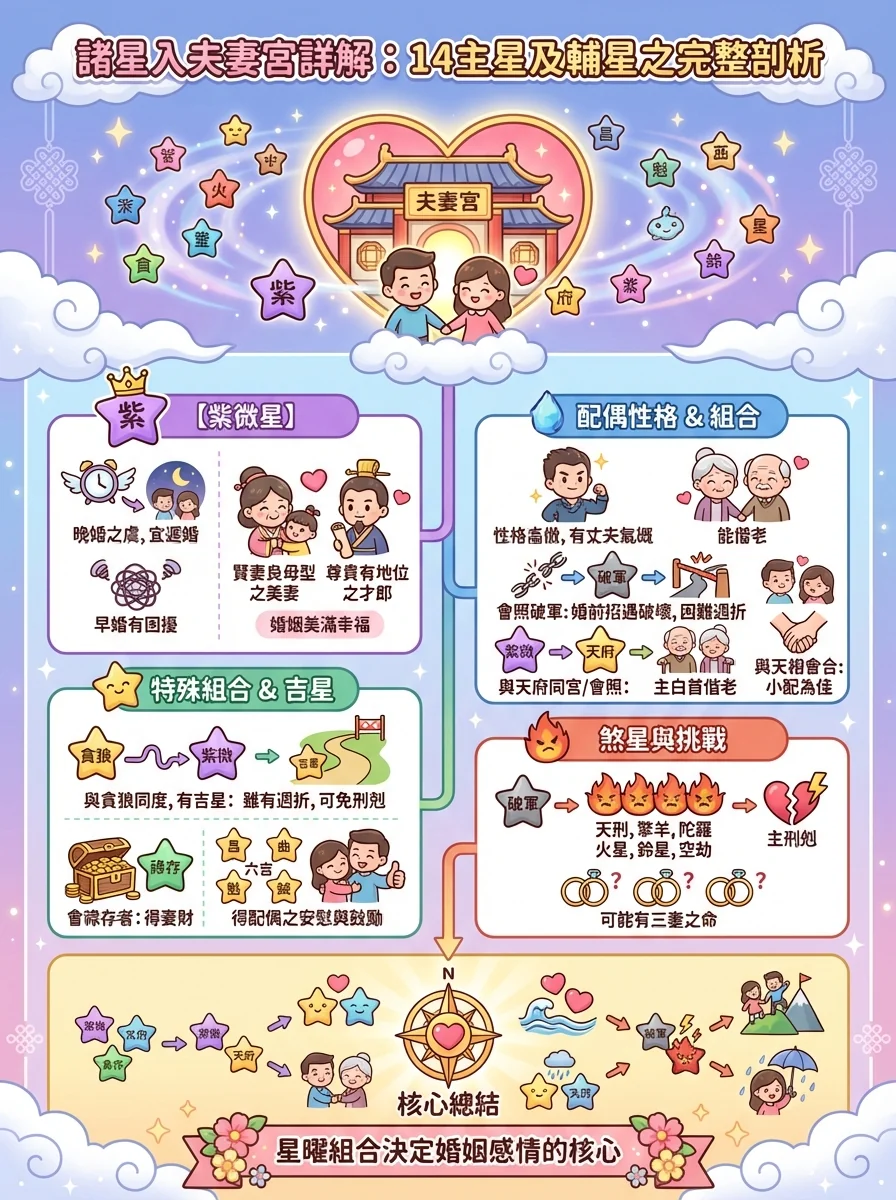
Detailed Explanation of Stars in the Spouse Palace: Complete Analysis of 14 Major Stars and Minor Stars
In Zi Wei Dou Shu, the star combination within the Spouse Palace is core to judging marriage and emotional relationships. Below, we will explain in detail what each major star and minor star means when entering the Spouse Palace.
【Zi Wei Star】
If the Zi Wei star enters the palace alone and strongly, it often indicates late marriage. For men, there's a high chance of marrying a beautiful, capable, virtuous wife; for women, marrying a husband with status and talent. The marriage will be happy and fulfilling, but it's better to marry later, as early marriage brings more troubles. Your partner's personality will be somewhat proud, with a bit of a chauvinistic/matriarchal tendency, but you can stay together until old age. If combined with Po Jun, there might be disruptions or difficulties before marriage. If in the Chen or Xu palaces, marital affection might be thinner. Combined with or meeting Tian Fu indicates growing old together. Combined with Tian Xiang, a younger partner is better. Combined with Tan Lang, if helped by auspicious stars, although there are ups and downs, conflicts can be avoided. Meeting Lu Cun brings wealth from the wife; meeting auspicious stars like Chang, Qu, Kui, Yue, Bi brings comfort and encouragement from the partner. If encountering Po Jun plus malevolent stars like Tian Xing, Qing Yang, Tuo Luo, Huo Xing, Ling Xing, Kong, Jie, it indicates conflicts, possibly leading to three marriages.
- Zi Wei Hua Quan: Indicates good career and family environment, partner has real authority.
- Zi Wei Hua Ke: Indicates good career and family environment, partner is very considerate.
- Zi Wei Tian Fu: A perfect match, like an immortal couple.
- Zi Wei Tan Lang: Prone to emotional troubles; similar age or synchronized schedules can help avoid issues.
- Zi Wei Tian Xiang: A younger partner is better.
- Zi Wei Qi Sha: A bickering but loving couple, often arguing artistically, or possible separation/bereavement.
- Zi Wei Po Jun: Marital disharmony; better if the woman is older or the wife's position/income is higher than the husband's.
【Tian Ji Star】
Often indicates early marriage pattern. Men marry a young, willful, or stubborn wife; women marry a husband younger or much older, with a large age gap—a younger wife with an older husband suits better. The partner tends to be busy, as Tian Ji governs household affairs. Couples are prone to disputes and arguments. A lifestyle of spending time apart actually improves the relationship. Meeting Lu Cun: men marry virtuous wives, women marry wise husbands. Meeting auspicious stars like Chang, Qu, Kui, Yue, Bi: partner is very intelligent and capable. Meeting malevolent stars like Yang, Tuo, Huo, Ling, Kong, Jie: marriage prone to cracks and estrangement; early marriage may lead to sleeping in separate beds or even divorce; late marriage is less problematic, but interests may differ greatly. People with Tian Ji in the Spouse Palace value spiritual life and atmosphere. Combined with Tai Yin: indicates a beautiful and helpful virtuous wife. Combined with Tian Liang: actually suits an older partner, or one at least six years younger; if not marrying late or without experiencing emotional changes before marriage, indicates separation or divorce.
同一個盤,前人走過怎樣的路?
- Tian Ji Hua Lu: Easily get help from opposite-sex colleagues at work.
- Tian Ji Hua Ke: Easily gain favor from opposite-sex colleagues at work.
- Tian Ji Hua Ji: Overthink emotions, emotional knots between partners, communication issues.
- Tian Ji Tai Yin: Partner has a very beautiful appearance.
- Tian Ji Ju Men: Partner has a strong, athletic build; a bickering but loving couple, harmonious but often nagging.
- Tian Ji Tian Liang: Partner is your dream ideal type; extreme age gap, but harmonious life.
【Tai Yang Star】
Partner is the capable and powerful type. Marriage is clear and simple. Men gain wealth and status through their wife; women are grateful. Tai Yang entering a strong palace (e.g., Yin, Mao, Chen, Si, Wu, Wei palaces) and meeting auspicious stars: men have a virtuous helpmate, respect their wife, wife is capable and healthy, gaining status through wife; women marry a wealthy husband. Better to marry late; early marriage leads to unhappy couples or conflicts. Tai Yang in a weak palace (e.g., Shen, You, Xu, Hai, Zi, Chou palaces) plus malevolent stars: not good for the wife, wife weak/sickly or early death; for women, prone to conflict with husband. Emotions can fade due to busy work. Meeting Tai Yin star: indicates a virtuous and beautiful wife, can grow old together. Meeting Po Jun: possible marriage due to premarital pregnancy. Meeting Qing Yang, Tuo Luo, Huo Xing, Ling Xing, Kong Jie, Tian Xing: indicates conflicts and separation. For women, Tai Yang in Xu, Hai, Zi positions; for men, in Mao, Chen, Si positions: marriage not ideal; meeting malevolent stars may indicate affairs.
- Tai Yang Hua Lu: Men have chance to achieve career success with wife's help; women have high chance of being a boss's wife.
- Tai Yang Hua Quan: Indicates partner is very capable and holds authority; men should be careful of differing opinions affecting marriage.
- Tai Yang Hua Ji: Unfavorable for women's marriage; for men, Spouse Palace conflicts with Career Palace, unfavorable for starting a business.
- Tai Yang Tai Yin: Harmonious and loving, can share both good times and hardships.
- Tai Yang Ju Men: A coordinated, ordinary couple; harmonious if in same palace without malevolent stars; with malevolent stars or Tai Yang in weak position, marriage is disharmonious or partner is very nagging.
- Tai Yang Tian Liang: Indicates happy and fulfilling marital affection, harmonious even in weak position with malevolent stars.
【Wu Qu Star】
Strong temperament, marriage often unsatisfactory, prone to arguments, prone to separation/bereavement. Men marry a strong-willed, independent wife who doesn't like going out; women tend to be solitary and marry late, husband is irritable and domineering. Better to marry late, or partner of similar age, or with similar interests, for harmony. If entering a strong palace, late marriage can avoid problems. Meeting Tian Fu, Lu Cun, six auspicious stars: gain property from partner, wife is virtuous and capable. Meeting Qi Sha, Po Jun: possibly three marriages. In the four tomb palaces (Chen, Xu, Chou, Wei): partner's personality is introverted. Women with Wu Qu: dominate family decisions, strong and decisive, support husband and不怕辛苦 (not afraid of hardship), many auspicious stars indicate a noble lady. With malevolent stars breaking through: restricts husband's development, solitary conflict.
- Wu Qu Hua Lu: Partner has strong personality, high ability.
- Wu Qu Hua Quan: Indicates partner is very strong-willed, prone to arguments; men might be henpecked.
- Wu Qu Hua Ke: Indicates partner is capable and considerate.
- Wu Qu Hua Ji: Indicates solitude; most unfavorable in Spouse Palace, too obsessive and strong about emotions, leading to late marriage, not marrying, prone to separation/bereavement.
- Wu Qu Tian Fu: Indicates harmony between couple, material help from partner.
- Wu Qu Tan Lang: Most realistic union; late marriage brings harmony due to wealth; early marriage leads to arguments over financial difficulties, even breakup.
- Wu Qu Tian Xiang: Marriage becomes formalized, poor感情 (emotions), often argue.
- Wu Qu Qi Sha: Prone to solitude, even bankruptcy due to partner.
- Wu Qu Po Jun: Indicates marital discord, partner is wasteful and willful, prone to arguments.
Feeling complex after reading this? Want to know which star resides in your Spouse Palace or see your 2026 romantic fortune? Actually, you can try Master Xuan Shen's Free Divination Service, results in as fast as 3 hours, completely free, can help you see more clearly!
【Tian Tong Star】
Harmonious and considerate type of marriage. Men get an intelligent, beautiful, virtuous helpmate, life progresses smoothly with wife's help; women marry a gentle, somewhat feminine, considerate husband, harmonious marital感情 (emotions). Must marry late to stay together until old age. Men better marry late but suitable to marry a younger woman; women also better marry late. Seeing six auspicious stars: good感情 (emotions). Meeting six malevolent stars: poor感情 (emotions) even divorce, or living apart. Combined with Tian Liang star: after divorce, remarry a beautiful woman. Women with Tian Tong guarding Spouse Palace: tendency to seize husband's authority; meeting malevolent stars breaking through indicates conflict with husband and children.
- Tian Tong Hua Lu: Partner helps your work and career.
- Tian Tong Hua Quan: Indicates partner knows how to enjoy life.
- Tian Tong Hua Ke: Indicates partner has wide interests, life is interesting.
- Tian Tong Hua Ji: Indicates marital感情 (emotions)不協調 (not harmonious).
- Tian Tong Tai Yin: Best to marry late, and husband older/wife younger is better, an "immortal couple who only admire lovebirds, not immortals."
- Tian Tong Ju Men: Partner is overly considerate and caring; if relationship is not good, can actually last until old age; if too intimate, partner's lifespan may not be long.
- Tian Tong Tian Liang: Eternal love, intimate and harmonious.
【Lian Zhen Star】
Marital life not very fulfilling, couple spends little time together, a relatively unfortunate marriage. Tendency to enjoy being mistreated or separation/bereavement; both men and women may have relationships with several members of the opposite sex, especially when meeting Tan Lang, Tian Yao, Kui, Yue, increasing chance of multiple marriages or affairs. Marital relationship harmonious but not very sweet, respectful like guests. Meeting Tian Fu, Tian Xiang: stay with a strong-willed partner, although arguments难免 (unavoidable), can last until old age. Meeting Sha Po Lang: marriage hard to find happiness, possibly mistreated, troubled by affairs, or separation/bereavement, even divorce and remarriage. In weak position:命 (destiny) of three marriages. Women with Lian Zhen in Spouse Palace: indicates conflicts, separation, or better as a second wife.
- Lian Zhen Hua Lu: Indicates partner is good-looking, has异性缘 (appeal to opposite sex), prone to romantic encounters.
- Lian Zhen Hua Ji: Indicates emotional不顺 (not smooth), marriage多波折 (many ups and downs), prone to emotional entanglements; conflicting with Career Palace can also bring legal troubles.
- Lian Zhen Tian Fu: Indicates harmonious感情 (emotions), but partner doesn't help.
- Lian Zhen Tan Lang: Indicates partner causes trouble,互相拖累 (mutual burden), not harmonious.
- Lian Zhen Tian Xiang: Indicates harmonious感情 (emotions), but得不到 (cannot get) partner's help.
- Lian Zhen Qi Sha: Indicates couple often argues,感情 (emotions) not harmonious, prone to physical altercations.
- Lian Zhen Po Jun: Indicates marital discord, partner arrogant and willful,目中無人 (looks down on everyone).
【Tian Fu Star】
Marital感情 (emotions) harmonious, spiritual life more important than material life. Partner intelligent and capable, material life affluent, marital感情 (emotions) harmonious and happy. Men: wife capable, respects wife, wife good at managing finances, working professional, manages household well; Women: husband chauvinistic, silent, stingy,感情 (emotions)平淡 (plain). Meeting six auspicious stars: family life圆满 (fulfilling) due to partner's talent. Meeting six malevolent stars: gap in partner's talent becomes reason for disharmony,恐怕 (afraid of)表面和諧內心疏離 (superficial harmony, inner estrangement), better marry late. Most怕 (fear) meeting空亡 (emptiness), having等于没有 (equals not having), leads to isolation.
【Tai Yin Star】
Partner outstanding in talent and appearance, marital life fulfilling. Get an elegant, refined partner; even more fulfilling and happy if in strong position. Men: wife beautiful, considerate, understanding, knows how to act cute, likes staying home serving husband, virtuous wife and mother type. Women: husband relatively weak, emotional多困擾 (many troubles), larger age gap better. In weak position: constrained or mistreated by partner, or partner可能早死 (may die early). Meeting six auspicious stars:感情 (emotions)融洽和諧 (harmonious). Meeting six malevolent stars: not harmonious even separation. Combined with Tian Tong or Tian Ji: indicates getting a virtuous helpmate good at managing household, intelligent and talented, but better to marry someone younger.
- Tai Yin Hua Lu: Men get virtuous and capable wife; women marry wealthy husband.
- Tai Yin Hua Quan: Indicates partner capable, actively starts business.
- Tai Yin Hua Ke: Indicates partner gentle and considerate.
- Tai Yin Hua Ji: Unfavorable for men's marriage; women lack strength to start business or prone to marrying a divorced man.
【Tan Lang Star】
Should marry late, otherwise hard to stay with partner until old age. If had sexual experience before marriage and marry late, couple can reach old age without conflicts. This star, like Lian Zhen, indicates婚姻有缺憾 (marriage with flaws), often tendency for multiple marriages and affairs due to sexual desire or精神不夾 (spiritual incompatibility). Men:感情 (emotions) relatively unstable,初期如膠似漆 (initially inseparable), later感情 (emotions)易出問題 (prone to problems), possible to change affections. Women: personality straightforward, style relatively modern, likes hearing sweet talk. Meeting Huo Xing, Ling Xing:收敛花心性格 (restrain flirtatious性格 (personality)) due to marital life.
- Tan Lang Hua Lu: Indicates both partner and oneself have异性缘 (appeal to opposite sex).
- Tan Lang Hua Quan: Indicates partner more active during courtship.
- Tan Lang Hua Ji: Indicates many Peach Blossom是非 (troubles), or房事不協調 (sexual incompatibility); partner适合学五术 (suited to study metaphysics).
【Ju Men Star】
Extremely possessive of opposite sex, emotions very intense, often argue with partner. A union lacking爱情 (romantic love),劳碌 (toilsome) due to burdens of marital life, or constrained/nagged by partner. Couple highly possessive, often argue due to jealousy, so larger age gap better. Men like wife to be glamorous type; women like husband to be from wealthy family. Meeting Tai Yang, Tian Ji, Tian Tong can stay together until old age. Meeting six auspicious stars:表面和諧內心疏離 (superficial harmony, inner estrangement). Meeting six malevolent stars:争执吵闹 (arguments and quarrels), even破裂生離 (breakup and separation). With malevolent stars, Hua Ji: prone to second marriage. Ju Men meeting Tian Xing, Tian Yao: indicates partner prone to affairs.
- Ju Men Hua Lu: Both men and women适合做情人 (suited to be lovers), but lack家庭责任感 (family responsibility).
- Ju Men Hua Quan: Indicates partner eloquent, must互相忍让 (tolerate each other), otherwise marriage易有风波 (prone to storms).
- Ju Men Hua Ji: Indicates夫妻意见不夹 (husband and wife opinions don't match), conflicting with Career Palace易惹人事纠纷 (prone to cause interpersonal disputes).
【Tian Xiang Star】
Best introduced by friends or亲戚上加亲 (marrying within relatives). Man older than woman, marrying relative or family friend, or marrying for love, a marriage with strong选择性 (selectiveness), generally happy and圆满 (fulfilling). Men get beautiful wife,乖巧 (well-behaved),贤慧 (virtuous). Women: husband做事积极 (works actively),责任心重 (strong sense of responsibility). Meeting Lu Cun: couple can cooperate,生活富裕 (life affluent), partner helpful. Meeting six auspicious stars:融洽幸福 (harmonious and happy). Meeting six malevolent stars:晴时多云偶阵雨 (sunny with occasional showers),雨过天晴 (clears after rain), even if not harmonious can last until old age. Meeting Chang, Qu:情感奔放 (emotions unrestrained),易被外来诱惑迷惑 (easily迷惑 (seduced) by external诱惑 (temptations)).
即時四柱五行排盤 + 命格角色卡,由十神實算,配以過萬真實命例大數據交叉分析。
【Tian Liang Star】
比较喜欢被另一半约束 (rather likes being constrained by partner). Woman older than man,家庭主权由女性掌握 (family authority held by woman),感情和睦 (emotions harmonious), a相敬如宾型婚姻 (respectful like guests type marriage). Men marry virtuous wife, but wife likes holding authority; women marry a管家老公 (husband who manages household). Economic power in partner's hands, but knows how to respect each other. Suits older partner, age差三岁以上 (gap over three years) better. Seeing Lu Cun:更显得互相敬爱 (even more shows mutual respect and love). Meeting six auspicious stars:感情融洽 (emotions harmonious). Seeing six malevolent stars: although often小吵小闹 (small quarrels),还算和睦 (still considered harmonious).
- Tian Liang Hua Lu: Indicates partner多荫福 (has much荫福 (blessing/protection)); men易得到外家帮助 (easily get help from wife's family); women易得到异性长辈关爱 (easily get care from opposite-sex elders) in work/career.
- Tian Liang Hua Quan: Indicates partner likes holding authority, eloquent.
- Tian Liang Hua Ke: Indicates partner likes holding authority but will respect your opinions.
【Qi Sha Star】
感情生活不顺遂 (emotional life not smooth), need to克制自己 (restrain oneself), late marriage better. Marriage unfavorable to partner,有伤害或者增加配偶负担的现象 (phenomenon of harming or increasing spouse's burden). Regardless of gender, partner's性情刚强 (temperament strong),易变 (changeable). During courtship,冷热都好快 (hot and cold quickly), mostly love at first sight, but hard to last long.感情淡薄 (emotions thin), if star combination not good,易有 (prone to) "鸳鸯半冷、同床异梦" (lovebirds half cold, sharing bed but dreaming different dreams) situation. Early marriage:夫妻不和睦 (husband and wife not harmonious); late marriage:不会克伤配偶 (won't harm spouse). Even meeting auspicious stars hard to maintain long-term harmony; if meeting six malevolent stars,必定主外遇或者结几次婚 (definitely indicates affairs or several marriages). Combined with Lian Zhen, with malevolent stars, also indicates separation/living apart.
【Po Jun Star】
不喜欢形式上的婚姻关系 (dislikes formal marital relationship), likes pursuing unrestrained emotional life, best marry late. A marriage that克伤配偶 (harms spouse),夫妻生活很难和谐 (marital life hard to harmonize). Partner's personality hard to grasp, opinions不易和谐 (not easy to harmonize). Prone to having关系 (relationship) before marriage,同居的事发生 (cohabitation happens) before/after marriage. If not叛徒 (traitor) of marital life, will see夫妻生离死别 (couple separation/bereavement). Meeting Zi Wei: better if wife older. If meeting auspicious stars, even old may have夫妻隔阂分离 (marital estrangement/separation). Meeting six malevolent stars:漠视婚姻 (disregard marriage),性生活浪漫随便 (sex life romantic and casual),必定换几次伴侣 (definitely change partners several times). Po Jun in Zi, Wu positions plus malevolent stars: marriage恐怕不止一次 (afraid不止 (not just) once).
- Po Jun Hua Lu:恋情精彩 (romance精彩 (exciting)), best marry late.
- Po Jun Hua Quan: Indicates partner奔波劳碌 (busy and toiling) for career.
【Minor Star Luminaries】
- Lu Cun Star: Best marry late, otherwise conflicts. Couple相生无克 (mutually generating without conflict), men适合娶少女 (suitable to marry young woman), women适合嫁老夫 (suitable to marry old man). Can get wealth brought by wife.
- Tian Ma Star: Has旺夫或帮夫运 (luck to prosper or help husband).热情 (passionate), willing to sacrifice for love. Indicates partner lives far away.
- Zuo Fu / You Bi Stars: Have超脱现实的想法 (detached from reality ideas) about感情事 (emotional matters), or like多姿多彩、富变化的感情生活 (colorful, changing emotional life). Entering Spouse Palace比较不利 (relatively unfavorable) for marriage, because they are辅助星 (assistant stars), combined with不好的煞星组合 (bad malevolent star combinations)时 (when),易有 "再一次" 的意思 (prone to meaning "once again"), may indicate second marriage or affairs.
- Chang / Qu Stars: Very attractive to opposite sex,感情初期甜蜜 (emotions sweet initially),生活和睦 (life harmonious), but fear婚外情 (extramarital affairs).特别敏感 (especially sensitive) to感情事 (emotional matters), prone to love at first sight.
- Tian Kui / Tian Yue Stars:夫妻和睦融洽 (husband and wife harmonious and融洽 (harmonious)),神仙眷属 (immortal couple). Indicates husband英俊 (handsome), wife靓女 (beautiful), get help from each other. Before marriage,易有人介绍对象给你 (easily有人 (someone) introduces对象 (potential partner) to you). Prone to思慕、仰慕长辈的缘分 (缘分 (fate) of admiring, looking up to elders).
- Huo Xing / Ling Xing: Best marry late, otherwise难白头偕老 (hard to grow old together). Couple热情 (passionate); if meeting malevolent stars,有刑克 (have conflicts),不安于室 (not content at home).
- Qing Yang / Tuo Luo Stars: Prone to being with个性刚烈的人 (people with strong personality),择偶和婚姻的理想异常严苛 (ideals for choosing spouse and marriage异常严苛 (exceptionally strict)),婚姻观念强烈 (marriage观念 (concept) strong),时有不睦 (often not harmonious).婚姻拖延 (marriage拖延 (delayed)),恋爱波折重重 (courtship重重波折 (full of obstacles)),婚后都未必幸福 (after marriage未必 (may not) be happy).
- Di Kong / Di Jie Stars:不要对爱情抱太大希望 (don't place too much hope in love),对夫妻生活充满憧憬幻想或物质欲望 (full of憧憬幻想 (fantasies) or material欲望 (desires) for marital life),而漠视现实 (while disregarding reality),增加另一半的精神或物质负担 (increase partner's spiritual or material burden),时有不和 (often not harmonious),甚至婚姻破裂 (even marriage破裂 (breakup)).
- Tian Yao Star:注重夫妻生活情趣 (pays attention to marital life情趣 (interest/fun)),无限柔情 (infinite柔情 (tenderness)). Indicates both sides have人缘 (popularity),多艳遇 (many romantic encounters). Meeting主星化忌 (major star Hua Ji), Po Jun, Zuo Fu, You Bi in same palace:易有重婚的可能 (prone to possibility of remarriage).
- Gu Chen / Gua Su Stars:婚姻生活的主观意识强 (subjective意识 (consciousness) of marital life strong),大多迟婚 (mostly marry late),婚后不易与另一半共处 (after marriage不易 (not easy) to coexist with partner),有精神孤独或形影孤单的倾向 (tendency for精神孤独 (spiritual loneliness) or形影孤单 (physical loneliness)). Indicates一生中易有一段时间与配偶分房或分居 (in life prone to一段 (a period of) time分房 (separate rooms) or分居 (separate living) with spouse).
Advanced Dynamic Analysis: Using Four Transformations and Flying Stars to Predict Emotional Changes and Avoid Marriage Pitfalls
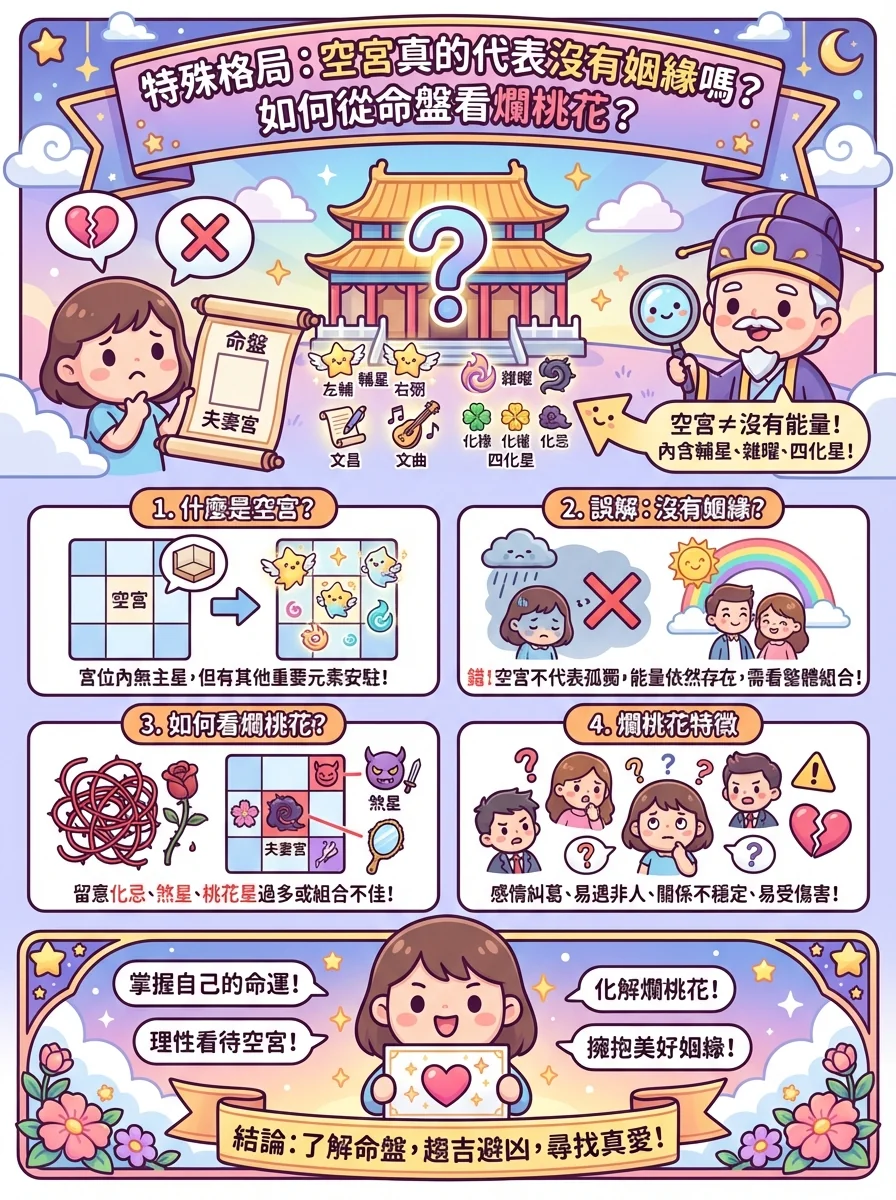
Special Patterns: Does an Empty Palace Really Mean No Marriage Luck? How to See Bad Peach Blossoms from the Destiny Chart?
【Does an Empty Palace Really Mean No Marriage Luck?】
Many friends open their destiny chart, see the Spouse Palace is an "empty palace," and their hearts immediately "turn cold," first reaction: "Huh? Empty palace? Does it mean I have no marriage luck, destined to be alone forever?" Actually, this is a very common misunderstanding. First, we need to clarify what "empty palace" means. In Zi Wei Dou Shu chart analysis, so-called "empty palace" doesn't mean the palace is truly empty with nothing. It means the palace doesn't have any "major star" placed within it (like the often-heard Zi Wei, Tian Ji, Tai Yang, Wu Qu, etc.). However, the palace still contains other very important elements, like "minor stars" (e.g., Zuo Fu, You Bi, Chang, Qu), "miscellaneous stars," and most importantly, the "Four Transformations stars" (Hua Lu, Hua Quan, Hua Ke, Hua Ji). So, a palace without a major star absolutely does not mean it has no energy or nothing happens; it just means the manifestation of that palace will be more influenced by other factors, with greater variability and reference to other elements.
So how to view an empty Spouse Palace? There's a very important rule in fortune-telling called "borrowing stars to establish the palace" or "referencing the opposite palace." Simply put, when a palace is empty, we need to look at the star combination in the opposite palace and "borrow" their characteristics for reference. The opposite of the Spouse Palace is always the Career Palace (i.e.,官禄宫 (Official Salary Palace)). Therefore, your spousal relationship and marriage pattern will be greatly linked to the characteristics of your career development. For example, if your Career Palace has emperor stars like "Zi Wei, Tian Fu," then your borrowed Spouse Palace may暗示 (hint) your partner is career-driven, has leadership ability, or your marriage is closely related to your social status and career achievements. Or, if your Career Palace has gentle stars like "Tian Tong, Tai Yin," then marital life may tend to pursue spiritual harmony and enjoyment. So, an empty palace isn't unreadable; you need to know how to "turn a corner" to interpret the chart.
Besides, judging an empty Spouse Palace also requires极度重视 (extreme重视 (importance)) on the "flying in and out" of the Four Transformations stars. Are there auspicious stars with Hua Lu flying into the Spouse Palace? Or malevolent stars with Hua Ji impacting it? These are the keys determining whether the marriage relationship is good or not. For example, even if the Spouse Palace is empty, but if Lu Cun or a Hua Lu star flies in from another palace, this is a strong signal indicating缘分 (fate) won't be lacking and may bring benefits or satisfaction.相反 (Conversely), if a Hua Ji star flies in, it may indicate more烦恼 (worries) on the emotional path, communication不顺 (not smooth), or需要经历一些考验 (need to undergo some tests), not directly meaning no marriage luck.
In summary, the answer to "Does an empty palace really mean no marriage luck?" is definitely a big "NO." An empty Spouse Palace only means your marriage课题 (topic/issue) needs to be借镜 (referenced) from the opposite palace (career) and pay more attention to the influence of the Four Transformations and minor stars. It may暗示 (hint) late marriage is more suitable, giving you more time to mature and know yourself, rather than early marriage; or提示 (prompt) you that cultivating stable career development will反而 (instead) drive a good spousal relationship. So, instead of worrying about an empty palace,深入学习 (deeply learn) how to correctly interpret your own destiny chart, understand the互动关系 (interactive relationships) within, then you can truly grasp your marriage fortune and make wiser life choices.
【Seeing Bad Peach Blossoms from the Spouse Palace】
Talking about using the Spouse Palace to see bad Peach Blossoms is truly the心声 (heart's voice) of many friends, especially those who often stumble on the emotional path. From a fortune-telling perspective, especially in Zi Wei Dou Shu and BaZi systems, the condition of the Spouse Palace can really reveal your lifelong emotional patterns and what types of partners you might encounter. So-called "bad Peach Blossoms" aren't just about感情没结果 (emotions without结果 (result)); they also include relationships that bring great emotional消耗 (drain), conflicts, and even affect your career and personal fortune. These relationships are like糖衣毒药 (sugar-coated poison), sweet at first but often leave you in a mess,伤神又破财 (draining and wealth-depleting).
How to see signs of bad Peach Blossoms from chart analysis? First, the most direct method is to see if the Spouse Palace contains any stars considered "malevolent." If the Spouse Palace sees stars like "Qing Yang," "Tuo Luo," "Huo Xing," "Ling Xing," it usually预示 (indicates) more波折同冲击 (ups and downs and impacts) on the emotional path. For example, "Qing Yang" governs快速而带伤害性的关系 (fast and伤害性 (harmful) relationships),可能是一见钟情但很快就因为激烈嗌交而散 (maybe love at first sight but quickly散 (break up) due to激烈嗌交 (intense arguments)); "Tuo Luo" is拖拖拉拉 (dragging on), a relationship纠缠好耐 (entangled for a long time),想断又断不到 (want to断 (cut off) but can't),极度消耗心神 (extremely消耗 (drains)心神 (mind/spirit)). If the Spouse Palace's major star itself is already relatively strong or fluctuating, like Qi Sha, Po Jun, plus these malevolent stars, then challenges on the emotional path become more obvious,容易遇到性格极端或者关系充满冲突的对象 (prone to encountering partners with extreme personality or relationships full of冲突 (conflict)).
Besides malevolent stars, a "Hua Ji" flying into the Spouse Palace from a star combination is also a very important signal for bad Peach Blossoms. Hua Ji represents阻滞 (obstruction),亏欠 (deficiency), and不开心 (unhappiness). When the palace representing emotions is invaded by Hua Ji energy, it's easy to attract partners who make you feel very辛苦 (hard-pressed),委屈 (wronged), or whom you constantly have to付出同收拾烂摊子 (付出 (give) and收拾烂摊子 (clean up messes) for). You may unconsciously陷入 (fall into)三角关系 (love triangles),不伦之恋 (improper relationships), or the other party isn't single but you're unaware. This type of relationship not only has no result but also严重打击 (severely打击 (hits)) your自信 (confidence) and信任 (trust) in感情 (emotions). Some destiny patterns with Hua Ji in the Spouse Palace also冲突 (conflict) with the opposite Career Palace, causing感情事 (emotional matters) to affect work too, truly赔了夫人又折兵 (lose the wife and折兵 (soldiers) - suffer double loss).
Another very common bad Peach Blossom pattern is seeing too many "Peach Blossom stars" in the Spouse Palace, or seeing stars like "Xian Chi," "Tian Yao," "Mu Yu," but without strong major stars to anchor or auspicious stars to resolve them. Many Peach Blossom stars indicate好人缘 (good popularity),异性缘重 (heavy异性缘 (appeal to opposite sex)), but also代表感情机会多而杂 (represent many and杂 (mixed) emotional opportunities),容易心猿意马 (prone to心猿意马 (indecisive)), or attract purely playful, non-serious partners. Under this combination, it's easy to have短暂 (short-lived)露水情缘 (fleeting romances) but hard to develop stable marital relationships. If the stars in the Life Palace or Virtue Palace are also偏向浮动 (leaning towards浮动 (unstable)), then the person's own心态 (mindset) may be unsettled, often游走 (wandering) between different partners, becoming the source of creating bad Peach Blossoms themselves.
So how to attract good and avoid harm? First, understanding your own emotional patterns through chart interpretation is key. If your Spouse Palace shows容易吸引烂桃花 (prone to attracting bad Peach Blossoms), then you need to be more谨慎 (cautious) in择偶建议 (partner selection advice). Second, you can adjust from the互动模式 (interaction模式 (pattern)) with your partner. Sometimes the formation of bad Peach Blossoms is related to our own性格同需求 (personality and needs). Fortune-telling analysis isn't宿命 (fatalism) but a人生地图 (life map),提醒 (reminding) you which road has more potholes, so you can be careful when walking it. Want to know if you have a bad Peach Blossom pattern, or how to avoid emotional traps in 2026? Why not try Master Xuan Shen's Free Divination Service? Results in as fast as 3 hours, completely free, many people say it's very accurate! The ultimate purpose of all divination and fortune-telling analysis tools is to help us understand ourselves better,从而 (thereby) make wiser choices, not be trapped by预言 (prophecies). Knowing you have a tendency for bad Peach Blossoms can反而 (instead) make you manage emotions with觉知 (awareness),避开明显的陷阱 (avoid obvious traps), slowly guide your emotional fortune towards a more正面 (positive),稳定 (stable) direction.
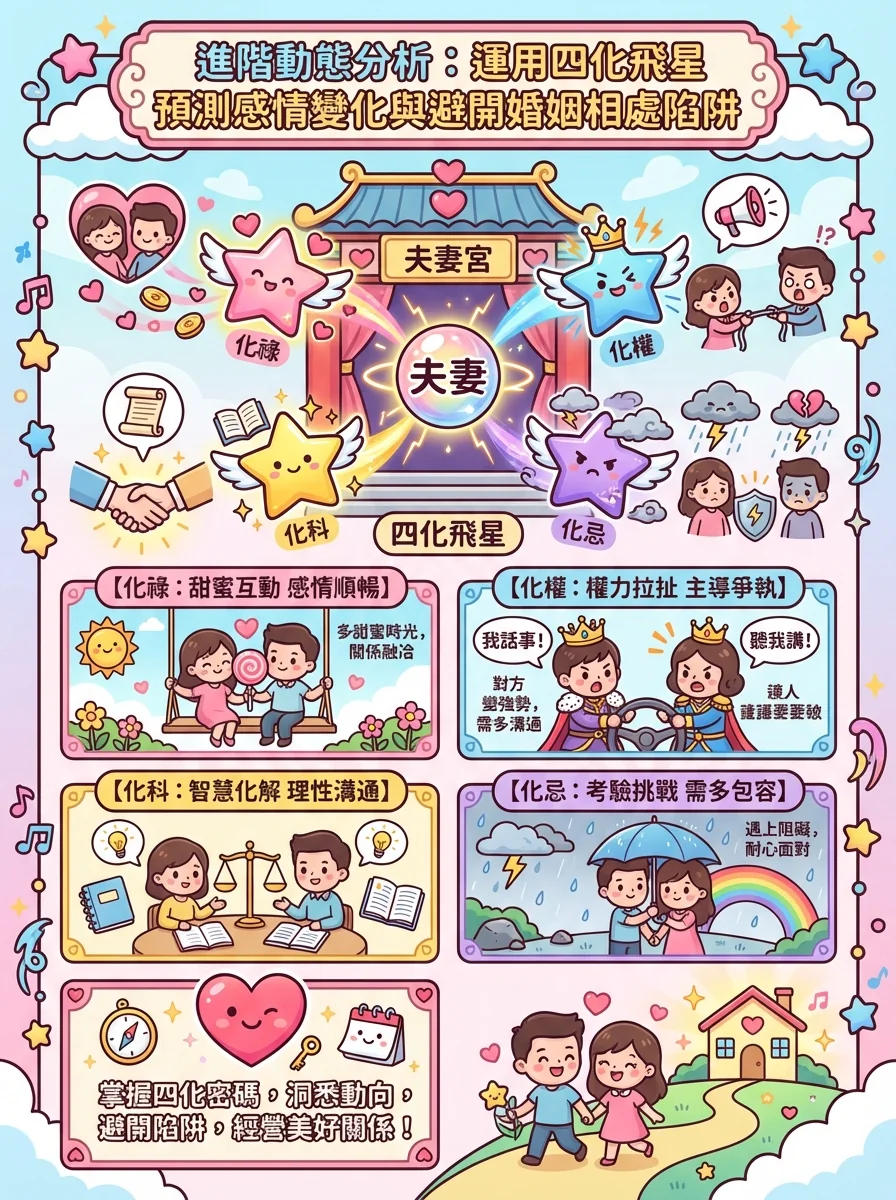
Advanced Dynamic Analysis: Using Four Transformations and Flying Stars to Predict Emotional Changes and Avoid Marriage Pitfalls
Advanced Dynamic Analysis: Using Four Transformations and Flying Stars to Predict Emotional Changes and Avoid Marriage Pitfalls
【Four Transformations and Flying Stars for Emotional Changes】
When it comes to "Four Transformations and Flying Stars," for those wanting to deeply understand the influence of the Spouse Palace, this concept is absolutely core of the core. Many friends look at charts只看 (only look at) major stars and malevolent stars; actually, the flying动向 (movements) of the Four Transformations (i.e., Hua Lu, Hua Quan, Hua Ke, Hua Ji) are the关键密码 (key codes) for seeing emotional changes and婚姻运势起伏 (marriage fortune起伏 (fluctuations)). They are like catalysts,激化或者缓和 (intensifying or缓和 (mitigating)) the power of stars within the Spouse Palace, directly affecting your interaction patterns with your partner,缘分深浅 (depth of connection), and even when you'll encounter major emotional turning points.
Simply put, the Four Transformations are "flow markers" of energy. For example, when "Hua Lu," representing顺利同机遇 (smoothness and opportunities), flies into your Spouse Palace,感情关系 (emotional relationship) in those years is usually smoother, with more sweet interactions.相反 (Conversely), if "Hua Quan" flies into the Spouse Palace, then the权力拉锯 (power tug-of-war) between you and your partner becomes more obvious. You might feel the other becomes very强势 (strong-willed), likes to call the shots, or you yourself unconsciously want to control the relationship. As for "Hua Ke," it's a温和 (gentle),名誉加持 (reputation-enhancing) energy. Hua Ke entering the Spouse Palace usually indicates a partner who is refined, polite, or the relationship can get外人祝福同认可 (outsiders' blessings and recognition). However, the one requiring most用心机去解读 (effort to interpret) is definitely "Hua Ji." Hua Ji mainly represents "obsession," "deficiency," and "不顺暢 (not smooth)." It could be your deep obsession and insecurity about marriage; or you feel you've付出好多 (given a lot) for your partner but好像得不到相应回报 (seem得不到 (cannot get)相应回报 (corresponding回报 (return))). Practically, Hua Ji in the Spouse Palace often reflects those "磨人" (grinding)琐碎事 (trivial matters) in marital life. So, rather than calling it an凶兆 (ominous sign), it's better as a clear提示 (prompt): in this relationship, which area needs your special付出耐性同智慧 (付出 (give) patience and wisdom) to "疏通" (疏通 (unblock)) and "化解" (resolve).
Four Transformations and Flying Stars aren't just about whether the Spouse Palace itself has them; more important is seeing "flying in" and "flying out." That is, you need to see where the Four Transformations from your本命盘 (natal chart) fly to, and which palaces' Four Transformations fly into your Spouse Palace. This forms a complex互动网络 (interactive network). For example: Suppose in your chart, the田宅宫 (Property Palace) representing home flies a "Hua Ji" into the Spouse Palace, then there's a high chance your marital relationship will be greatly affected by family members or housing issues. Or, if a star from your Spouse Palace flies a "Hua Quan" to your官禄宫 (Career Palace) representing career, then it may暗示 (hint) your partner directly affects your career choices, or your marital status is tightly bound with your social status and career achievements.
For friends planning marriage compatibility or experiencing emotional changes, understanding Four Transformations and Flying Stars is particularly helpful. For instance, if the major cycle (ten-year运程 (fortune)) you're currently in has a Hua Lu flying into your natal Spouse Palace,感情 (emotions) in these ten years usually have滋润 (nourishment), happy development; but if it's a Hua Ji冲起 (conflict arising), then be prepared, relationship will face tests during this time. In summary, through the "Four Transformations and Flying Stars"这套动态系统 (this set of dynamic systems), we can see when emotional fortune will升温 (heat up), when it will冷战 (cold war), when it faces现实挑战 (realistic challenges). Combining flying stars with宫内星曜组合 (intra-palace star combinations) for reference, you can get a very个人化同精细 (personalized and精细 (detailed)) marriage prediction and partner selection advice.
【Avoiding Marriage Interaction Pitfalls】
Within marital relationships, there are always different pitfalls and摩擦位 (friction points). If you can get early warnings through fortune-telling analysis beforehand, it's like having a "risk avoidance map" for interaction. To avoid marriage interaction pitfalls, first understand the Spouse Palace isn't an孤立的存在 (isolated existence); it interacts with other palaces in the chart. A资深 (senior) master解盘 (interpreting chart)时 (when), won't单单看 (only look at) whether the Spouse Palace has auspicious stars, but will全面分析 (comprehensively analyze) whether the三方四正 (three directions and four正 (upright) - surrounding palaces) (i.e.,迁移宫 (Migration Palace),官禄宫 (Career Palace),福德宫 (Virtue Palace)) have malevolent stars冲激 (impacting), because these外围的影响 (peripheral influences) are often the external pressures引发夫妻矛盾 (triggering夫妻矛盾 (couple conflicts)). For example, the Spouse Palace itself has a good pattern, but the opposite Career Palace sees强势的煞星 (strong malevolent stars), may代表另一半的事业压力极大 (represent partner's career pressure极大 (extremely great)), often bringing work emotions home, forming无形隔阂 (invisible estrangement).
After understanding the宏观 (macro) chart analysis framework, then微观 (micro) look at star characteristics. Each major star represents a basic interaction模式同期望 (pattern and expectation). If the chart owner's own性格 (personality) is completely opposite to the partner's期望模式 (expectation模式 (pattern)), then it's easy to fall into the "互相误解" (mutual misunderstanding) trap. For a more practical example: if the Spouse Palace sees certain star combinations representing务实同慳家 (practical and thrifty), but the chart owner themselves pursues生活情趣 (life情趣 (interest/fun)), spends money比较阔绰 (relatively generously), then金钱运用分歧 (money usage分歧 (differences)) will become a持续摩擦点 (continuous friction point) in marriage. The value of fortune-telling analysis is, it doesn't判决 (judge) you "not compatible," but精准指出 (precisely points out) "where not compatible," allowing both sides to establish effective沟通同协商机制 (communication and协商机制 (negotiation mechanisms)) before problems erupt into major conflicts.
Another common interaction trap relates to the concept of "conflicts and clashes." In modern fortune-telling application, "conflicts and clashes"更多指向 (more point to)性格上的摩擦 (personality friction),价值观的冲突 (value conflicts), or照顾压力 (care pressure) due to health issues. For example, seeing certain specific malevolent star combinations in the Spouse Palace may暗示 (hint) partner's personality is比较急躁 (relatively impatient), or health needs special attention. Knowing this, the chart owner can主动避开 (actively avoid) some communication methods引发争执 (triggering arguments), or arrange regular身体检查 (health check-ups), putting关怀付诸行动 (care into action). This趋吉避凶 (attracting good, avoiding harm) approach is precisely transforming traditional fortune-telling wisdom into practical strategies for modern marriage maintenance.
For friends正在择偶 (currently choosing partner) or planning late marriage, Spouse Palace analysis can help you avoid the "识错人" (knowing wrong person) trap. Through the stars in your own chart's Spouse Palace, you can understand what type of特质 (traits) you are most easily attracted to潜意识 (subconsciously), while also seeing what spouse traits can truly互相扶持 (mutually support) you in the long run. The fortune-telling master's role is like an经验丰富的顾问 (experienced consultant), helping you interpret this complex "人生互动说明书" (life interaction manual), allowing you to make more清醒的选择 (清醒 (clear-headed) choices). Finally, to effectively avoid traps, must maintain正确的心态 (correct mindset). Fortune-telling tools provide趋势分析同可能性预测 (trend analysis and possibility predictions), not无法改变的宿命 (unchangeable宿命 (fate)). Knowing the Spouse Palace has波折 (ups and downs) doesn't mean消极认命 (passively认命 (accept fate));反而 (instead)更应该积极学习 (should更 (more) actively learn)夫妻相处之道 (ways of couple相处 (getting along)),情绪管理 (emotional management). The auspiciousness or inauspiciousness of marriage fortune often一半都是看个人后天的努力同选择 (half depends on individual后天 (postnatal) efforts and choices). If you want to更深入了解 (more deeply understand) your own destiny, prepare for the 2026 emotional path, why not try Master Xuan Shen's Free Divination Service? Results in as fast as 3 hours, completely free, really worth trying!
In physiognomy, where is the "Spouse Palace" located on the face?
In physiognomy, the Spouse Palace is located in the area extending from the tail of the eye to the temple. This area is also known as the "Jian Men" (Adultery Gate). The condition of this area, such as whether it is full, lustrous, or has scars or moles, is believed to reflect a person's marriage and emotional fortune. An ideal Spouse Palace should be smooth, full, lustrous, and free of blemishes.
What exactly does "Spouse Palace" mean? Is it only about physiognomy?
"Spouse Palace" is a concept originating from Chinese metaphysics and is not limited to physiognomy. In Zi Wei Dou Shu (Purple Star Astrology) or BaZi (Eight Characters) fortune-telling, it is also a very important analytical palace used to interpret a person's views on love, marital status, partner selection criteria, and interaction patterns with their significant other. Therefore, it is a comprehensive concept covering both physiognomy and destiny chart analysis.
Can the Spouse Palace show me what my future partner will be like?
Yes, one of the main functions of the Spouse Palace is to outline the profile of your partner. Whether through physiognomy or chart analysis, it can be used to infer the other party's possible personality traits, appearance, family background, and even occupational type. However, remember that these are indications of trends, not absolute certainties.
If the Spouse Palace on the face is sunken or has lines, does it definitely mean the marriage will be bad?
A sunken Spouse Palace or one with lines, in traditional physiognomy, might be interpreted as a more turbulent emotional path or a need to put more effort into managing the marriage. But in 2026 today, we shouldn't be so fatalistic. These features should be seen more as a reminder,提示 (prompting) you to invest more communication and understanding in your emotional relationships. Postnatal effort can definitely change the situation.
I've heard that having "malevolent stars" in the Zi Wei Dou Shu Spouse Palace is very bad, is that true?
On a Zi Wei Dou Shu destiny chart, the appearance of malevolent stars (e.g., Qing Yang, Tuo Luo, Huo Xing, Ling Xing, etc.) in the Spouse Palace does not mean your marriage is doomed to fail. It more points out specific "challenges" you may encounter in emotional relationships, such as being prone to arguments, the relationship容易冷淡 (easily turning cold), or being受外界干扰 (affected by external interference). Understanding these challenges can反而 (instead) allow you to prepare in advance to应对 (deal with) them.
Is it true that couples who are together for a long time develop more "couple resemblance"?
The saying "couple resemblance" is very interesting. Although not directly related to the fortune-telling "Spouse Palace," it确实存在 (does exist) in real life. This phenomenon can be explained from psychological and lifestyle perspectives. When two people live together long-term, their eating habits,作息时间 (schedules), and even facial expressions influence and converge with each other, gradually producing a相似的感觉 (similar appearance) over time.
If the Spouse Palace shows my emotional fortune isn't very good, are there ways to improve it?
Absolutely! Chinese metaphysics strongly emphasizes "one's destiny, two's luck, three's Feng Shui." The destiny chart or physiognomy is only the先天蓝图 (innate blueprint); postnatal effort is key. If your Spouse Palace shows challenges, you can start improving from several aspects, such as enhancing personal cultivation, adjusting home Feng Shui, and most importantly—changing your mindset and behavior when handling emotional problems.
In 2026, how should we interpret the Spouse Palace with a modern perspective?
Entering 2026, we should view the Spouse Palace with a more scientific and flexible mindset. Rather than seeing it as a宿命工具 (fatalistic tool) for predicting the future, treat it as a "personal emotional relationship manual." It can help us understand our innate nature, blind spots, and potential in love,从而 (thereby) allowing us to more consciously choose and manage a healthy, equal modern伴侣关系 (partner relationship).